
What Is AI Marketing? Benefits, Uses & Strategies for 2026
 Neeraj Kirola
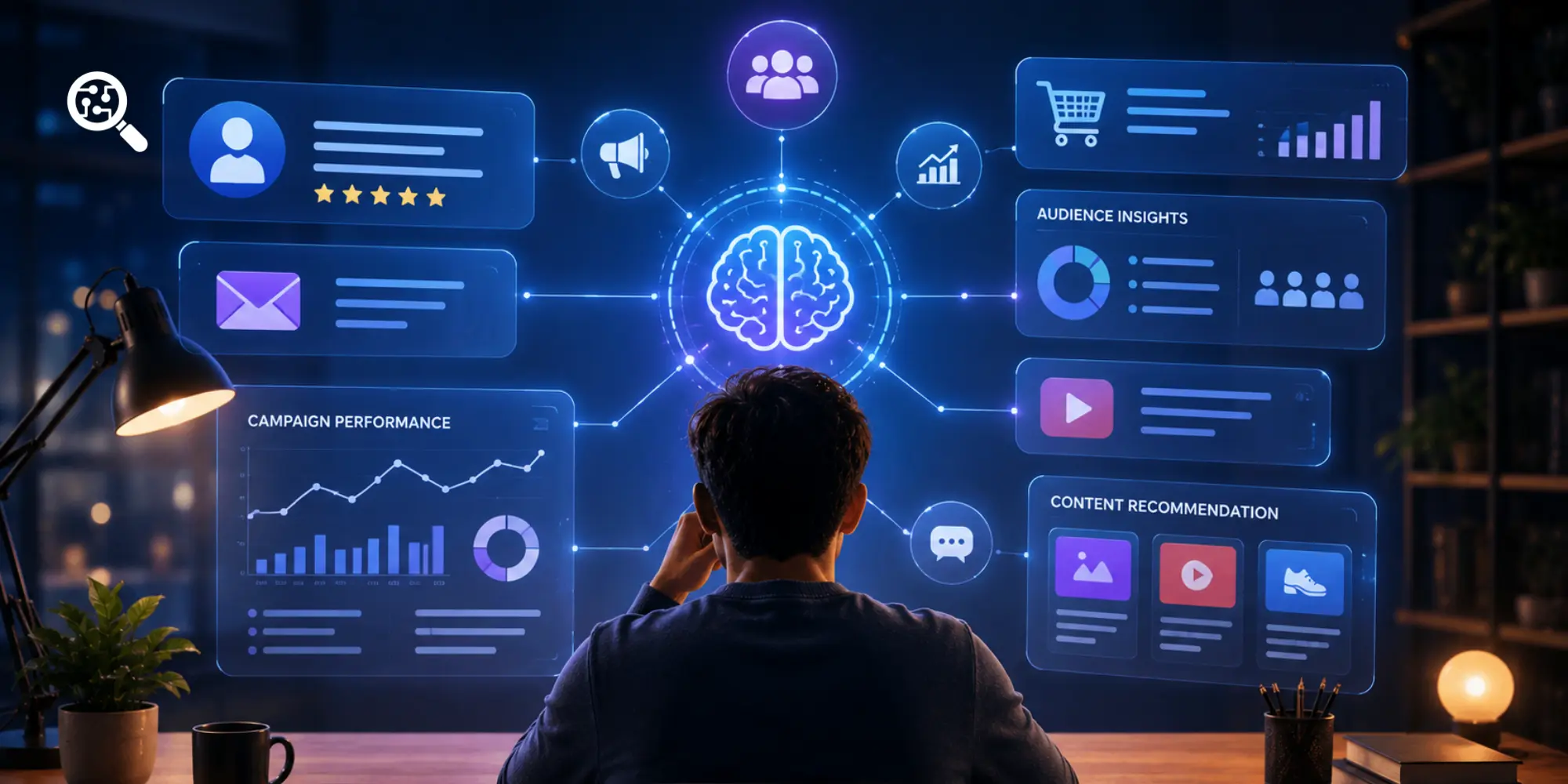
Marketing teams have always tried to answer the same basic questions: Who is most likely to buy? What message will get their attention? Which channel should receive more budget? Why did a campaign work? What should we do next?
What has changed is the amount of information marketers can use to answer those questions and the speed at which decisions can now be made.
AI marketing applies technologies such as machine learning, language models, predictive analytics, recommendation systems, sentiment analysis, and increasingly autonomous agents to marketing data and workflows. It can help marketers understand large audiences, generate and adapt content, personalize customer experiences, predict outcomes, automate repetitive work, analyze competitors, improve advertising, and respond faster to changes in customer behavior.
Adoption is no longer limited to experimental teams. Salesforce's 2026 State of Marketing findings report that 75% of surveyed marketers have adopted AI. The same research found that 78% say they need more personalized content than they can currently produce, highlighting why personalization and production capacity have become major use cases.
The opportunity, however, is not simply to produce more campaigns at lower cost. The better question for 2026 is where AI improves marketing decisions and execution without removing the human judgment that makes marketing relevant, original, and trustworthy.
What Is AI Marketing?
AI marketing is the use of artificial intelligence to analyze marketing information, support decisions, automate tasks, generate or adapt content, predict customer behavior, and improve how brands interact with their audiences.
Sprout Social defines AI marketing around using artificial intelligence to inform, automate, and improve marketing processes and decisions across areas such as social listening, content creation, advertising, personalization, and customer care.
In practice, that could mean using a language model to help draft an email, a recommendation engine to personalize products on an ecommerce site, predictive models to identify customers likely to churn, or a system that analyzes thousands of customer comments to identify an emerging complaint before it develops into a larger problem.
There is also an important distinction between assistance and delegation. Many marketing applications help marketers complete individual tasks. Newer agentic systems can coordinate several tasks toward a goal, such as monitoring a brand, investigating a sudden sentiment shift, gathering context, and preparing a recommended response.
For marketers exploring that shift, AI Tool Hunt has a dedicated AI marketing tools directory covering different marketing use cases.
How Is AI Used in Marketing?
AI is not one marketing channel or one type of software. It increasingly appears throughout the customer journey, from research and planning to acquisition, conversion, support, and retention.
The most useful applications are usually not those where a company asks, “Where can we add AI?” They are the places where teams already have an identifiable problem involving too much information, repetitive manual work, slow decision-making, or personalization that would be difficult to deliver manually.
1. Customer Research and Audience Insights
Marketing teams collect enormous amounts of information through website behavior, transactions, CRM records, surveys, support conversations, reviews, advertising, email, and social media. The problem is rarely collecting more data. It is making sense of what is already available.
Machine learning and language-based systems can process this information at a scale that would be difficult for a team to review manually. They can help group customers by behavior, identify recurring complaints, detect sentiment changes, highlight purchasing patterns, and uncover topics appearing across thousands of customer conversations.
Park University highlights this ability to combine browsing behavior, purchase history, and social engagement to create a clearer view of customer behavior and identify trends or churn risks.
This does not mean the model should decide what customers “really think” without verification. Customer intelligence works best when the system helps marketers surface patterns and the marketing team investigates why those patterns exist.
2. Personalization at Scale
Personalization used to mean adding someone's first name to an email. Modern personalization can influence the products shown to a visitor, offers displayed, email content, website experience, timing of communication, recommendations, and sometimes the channel through which a person is contacted.
AI helps because these decisions can incorporate many more behavioral signals than a marketer could manually manage.
A retailer could use browsing history, previous purchases, product affinity, geographic location, and recent behavior to decide which categories should be emphasized for a customer. A streaming platform might recommend content based on viewing patterns. A B2B company could personalize website messaging according to account type and buying stage.
The goal should not be personalization simply because it is technically possible. A useful personalized experience helps the customer make a decision or find something more relevant. Poor personalization can feel intrusive or expose how much information a company has collected.
This is also where data quality matters. Salesforce's 2026 research found that 98% of surveyed marketers encounter barriers to personalization, with data-related problems among the most common. A sophisticated personalization model cannot compensate for fragmented or inaccurate customer information.
3. Content Creation and Repurposing
Content generation is probably the most visible use of AI in marketing, but treating it purely as a way to publish more articles and social posts misses much of its value.
Marketing teams can use generative systems to brainstorm angles, develop outlines, create first drafts, summarize interviews, adapt a campaign for different channels, produce product descriptions, rewrite email copy, create variations for testing, generate visual concepts, and turn one piece of content into several formats.
A good workflow still starts with human inputs. The marketer defines the audience, message, point of view, supporting evidence, brand requirements, and business goal. The system accelerates production rather than inventing expertise that the company does not possess.
This matters because audiences are becoming less tolerant of generic material. Sprout Social's Q1 2026 Pulse Survey found that 40% of surveyed social users said they had unfollowed, muted, or blocked a brand or creator they suspected of posting low-quality AI-generated content, while 66% said they had become more selective about what they engage with because of AI.
For marketers who mainly need assistance with production, AI content tools can support drafting and repurposing without requiring an entire marketing stack to be replaced.
4. SEO, AEO and Search Discovery
Search marketing is undergoing a particularly important change because people are no longer discovering information only through traditional lists of blue links.
Google's AI-generated results, ChatGPT, Gemini, Perplexity, and other answer-oriented systems can synthesize information directly for the user. This means marketers increasingly need to think about both traditional search visibility and whether their information is understandable and trustworthy enough to be referenced in generated answers.
Salesforce's 2026 marketing research found that 85% of marketers say AI is reshaping their SEO strategy, while 48% say they have not yet figured out how to adapt their strategy to widespread AI use.
The fundamentals have not disappeared. Useful original information, clear site architecture, crawlability, relevant internal linking, trusted sources, expert authorship, strong entities, and content that directly addresses user questions remain important.
What is changing is the format of discovery. Marketers now also benefit from clearly stated definitions, comparison tables, concise answers to important questions, structured data where appropriate, transparent sourcing, updated statistics, and pages that are easy for both people and systems to understand.
For teams specifically working on organic visibility, AI Tool Hunt's AI SEO tools directory covers tools designed around search research, optimization, and related workflows.
5. Predictive Analytics and Forecasting
Traditional marketing analytics explain what happened. Predictive analytics attempts to estimate what may happen next.
Using historical data, models can help estimate purchase probability, churn risk, campaign response, customer lifetime value, future demand, and other outcomes. Park University identifies lead conversion likelihood, purchase timing, and trend forecasting among the practical applications of predictive marketing.
The value is not that a forecast is guaranteed to be correct. It is that marketers can prioritize resources based on probabilities rather than treating every customer or campaign equally.
For instance, a retention team might prioritize customers showing several signals associated with churn, while a paid acquisition team might shift spending toward audience segments consistently producing higher-value customers.
These predictions should be monitored for drift and bias. Customer behavior changes, markets change, and a model trained on old patterns can become less useful over time.
6. Advertising and Media Buying
Digital advertising has used machine learning for years, particularly in bidding, audience targeting, campaign optimization, and creative selection. Many marketers are therefore already using AI even when they do not interact with a chatbot.
Programmatic advertising systems can assess available placements, predicted conversion likelihood, campaign objectives, and other signals to determine where budget should be allocated. Creative systems can also generate multiple headlines, visuals, or ad versions and help marketers test combinations more efficiently.
Park University's competitor article highlights automated bidding, targeting, and real-time adjustments as important applications in digital advertising.
Automation should not remove strategy. A system can optimize toward the metric it is given, but marketers still need to decide whether that metric reflects the actual business objective. Maximizing clicks is not useful if those clicks rarely produce qualified leads or profitable customers.
7. Email Marketing
Email provides a good example of how AI can improve an established marketing channel without completely changing how the channel works.
Systems can help analyze send times, engagement patterns, subject lines, customer segments, content preferences, and previous behavior. They can create draft variations, personalize product recommendations, identify customers likely to disengage, and help determine which messages should be sent to different audiences.
Park University specifically identifies send-time optimization, subject-line selection, content formatting, and campaign testing as common applications.
The most useful applications usually improve relevance rather than simply increasing frequency. Sending twice as many automated emails does not necessarily create twice as much value. In many cases, better segmentation and fewer irrelevant messages will outperform higher volume.
8. Social Listening and Reputation Management
A marketing team cannot manually read every mention of a large brand across social platforms, reviews, forums, news, and customer conversations.
Natural language processing and sentiment analysis can help group conversations by topic, identify recurring themes, detect changes in sentiment, and surface unusual activity. Sprout Social describes systems that analyze topics, contextual language, slang, and sentiment to help marketers understand what audiences are discussing.
This is useful for more than producing social posts. A sudden increase in complaints around a product feature might be relevant to product teams. An emerging competitor can influence positioning. An unexpected positive theme can become a campaign opportunity.
For brands with high social volume, AI social media tools can help with analysis, publishing, content support, and monitoring.
9. Customer Service and Conversational Marketing
Marketing does not stop when someone becomes a customer.
Chatbots and conversational systems can answer routine questions, help people navigate products, collect lead information, route conversations, summarize histories, and support customer-service teams.
Sprout Social's competitor article describes systems that triage incoming messages and summarize long customer threads, allowing human representatives to spend more time on conversations requiring judgment.
The best use of automation here is not always removing the person. It is identifying which interactions can be resolved quickly and which require empathy, flexibility, or authority.
A customer asking “What are your opening hours?” may not need human attention. Someone who has experienced the same order failure three times probably does.
10. AI Agents and Marketing Automation
One of the biggest changes in 2026 is the movement from tools that perform individual tasks toward agents that can coordinate several tasks toward a marketing objective.
A traditional content tool might create an email. A marketing agent could potentially identify which customer segment requires attention, retrieve relevant data, determine an appropriate message, prepare the campaign, and ask for approval before execution.
A competitive-intelligence agent could monitor approved information sources, detect an important competitor change, gather context, summarize the implications, and create a briefing for the marketing team.
This is different from traditional automation because the path does not always have to be predetermined. Agents can potentially decide which tools and actions are required based on what they discover.
That does not make agents appropriate everywhere. Higher autonomy introduces greater requirements around data access, permissions, testing, monitoring, and human approval. Marketers interested in this area can exploreAI agent tools, but the right starting point is still the business problem rather than the technology.
Benefits of AI in Marketing
The strongest benefit is not simply speed. It is the ability to use more information while reducing the manual effort required to act on it.
Marketing teams can execute routine work faster, analyze larger datasets, identify customer patterns earlier, create personalized variations at a scale that would be expensive manually, and automate repetitive activities such as reporting or categorization. Park University groups these advantages around efficiency, targeting, personalization, performance measurement, and scalability.
There is also a capacity benefit. Salesforce's global 2026 research found that 88% of marketers already using AI say it helps them do their jobs better, and the same percentage say it lets them spend more time on the parts of their jobs they enjoy.
Those benefits depend heavily on implementation. Automating a poor process simply makes the poor process run faster. Generating more content does not help when that content is generic. Creating thousands of customer segments does not help when the data used to build those segments is unreliable.
The business case should therefore be connected to measurable problems rather than the number of features a platform offers.
Risks and Challenges of AI Marketing
The same systems that make marketing more scalable can also magnify mistakes.
Data privacy is one of the biggest concerns because personalization and predictive marketing often depend on customer information. Businesses need to understand what data is collected, whether customers have provided appropriate consent, how information is stored, and which vendors can access it. Park University specifically identifies privacy, transparency, manipulation, algorithmic bias, and overdependence on automated decisions as important ethical issues.
Brand authenticity is another concern. When every organization can produce large volumes of competent-looking content, volume becomes less valuable as a differentiator. Original research, real customer experiences, expert opinion, useful data, distinct creative ideas, and strong brand perspective become more important.
Hallucinations and inaccurate outputs also remain relevant. Marketing copy can contain invented product features, incorrect statistics, fabricated customer quotes, or claims that have no supporting evidence. Important facts should be checked against the original source before publication.
Over-automation can create a different problem. A campaign may technically be optimized while becoming less human. Sprout Social argues that the strongest use of automation is to remove repetitive work without removing judgment from situations where judgment matters.
Finally, businesses need clear governance. Teams should know which systems are approved, what data can be uploaded, which outputs require review, whether generated content needs disclosure, and who is responsible when an automated workflow makes a mistake.
How to Build an AI Marketing Strategy
Do not begin by purchasing ten new tools. Begin by identifying where the marketing team is losing time or information.
Sprout Social recommends starting with an audit of manual workflows and prioritizing activities according to effort and impact before moving into more complex implementations. That is a sensible approach because an easy, measurable improvement can tell you far more than a large experimental deployment.
Step 1: Identify the Marketing Problem
Start with a concrete issue such as:
- content production takes too long
- customer feedback is not being analyzed
- lead qualification requires too much manual work
- reporting takes several hours each week
- personalization is limited
- customer-service response times are increasing
- campaign insights arrive too late
Do not start with “we need an AI strategy.” Start with the bottleneck.
Step 2: Decide What Should Remain Human
Separate repetitive work from work that requires brand judgment, customer empathy, strategic decisions, or accountability.
A system might generate five subject-line ideas, but the marketer can choose which one matches the campaign. It might summarize customer complaints, while a product manager decides which problem deserves attention.
The objective is not maximum automation. It is the right division of responsibilities.
Step 3: Choose the Smallest Suitable Tool
A content-generation problem may need a writing tool rather than an agent. A straightforward publishing schedule may need conventional automation rather than a reasoning system.
Choose the simplest technology capable of solving the problem reliably.
Step 4: Define Success Before Deployment
Measure the outcome rather than simply measuring usage.
Useful metrics can include:
| Use Case | Useful KPI |
| Content workflow | Production time, editing time, engagement |
| Customer support | Response time, resolution rate, CSAT |
| Advertising | CPA, ROAS, qualified conversions |
| Conversion rate, revenue per recipient, unsubscribe rate | |
| Social listening | Time to insight, response time, sentiment trends |
| SEO/AEO | Qualified organic traffic, visibility, leads, citations |
| Personalization | Conversion lift, retention, revenue per visitor |
| Automation | Hours saved, error rate, cost per completed workflow |
Step 5: Test, Review and Expand
Run the workflow on real tasks and compare the results against the old process. Look for time saved, errors introduced, customer impact, quality differences, and whether employees actually prefer using the new approach.
Expand only after the workflow creates measurable value.
Sprout Social's implementation framework makes the same point: track metrics connected to the original goal and use the results to decide where expansion is justified.
What Is the Future of AI in Marketing?
The next stage is likely to involve less separation between “AI tools” and ordinary marketing software.
Predictive analytics, generation, search, recommendation systems, customer intelligence, and agents are increasingly becoming features inside platforms marketers already use. Instead of opening a separate application for every task, teams will increasingly expect marketing systems to analyze information, recommend an action, and sometimes execute approved steps directly.
Search discovery is changing at the same time. Salesforce's 2026 findings show that 85% of marketers say AI is already reshaping SEO, which means marketing strategies increasingly need to account for discovery through generated answers as well as conventional search results.
The role of human marketers is therefore unlikely to disappear simply because more production and analysis can be automated. The valuable human contribution shifts further toward positioning, judgment, original ideas, customer understanding, creative direction, ethical decisions, source verification, and deciding which problems are worth solving.
The marketers who benefit most will probably not be those who automate the highest percentage of their work. They will be the teams that know which work should be automated, which decisions need people, and how to combine both without sacrificing trust.
Final Thoughts
AI marketing in 2026 is no longer mainly about asking a chatbot to write a social caption. It now reaches across audience research, personalization, predictive analytics, paid advertising, content production, SEO and answer-engine discovery, customer care, competitive intelligence, and increasingly agentic workflows that can coordinate several tasks at once.
That wider capability makes strategic discipline more important, not less. Teams need reliable data before they can personalize effectively, clear objectives before they automate a workflow, human review before questionable output reaches customers, and meaningful KPIs before claiming that a new system improved marketing performance. The strongest competitor research points to the same tension: automation and personalization can create significant efficiency, but privacy, transparency, brand authenticity, and human judgment remain central to responsible implementation.
Frequently Asked Questions
Featured AI Tools





Top Categories
You Might Also Enjoy
More articles from our blog that you may find interesting.
Generative AI vs Machine Learning: Key Differences Explained
Generative AI and machine learning are closely related, but they are not interchangeable terms.Machi...

Gemini vs ChatGPT: Which Is Better in 2026?
Gemini and ChatGPT have become much harder to separate than they were a few years ago. Both can sear...

What Are AI Agents? How They Work, Types & Examples (2026)
Software has traditionally required people to tell it exactly what to do. You click a button, fill i...

10 Best Free AI Tools You Can Use in 2026
You do not need ten paid subscriptions to get useful work done with AI in 2026. Many of the most cap...

How to Create a Website With AI
Creating a website used to mean choosing between two options: learning how to build one yourself or...

Art of Prompting: How to Write Better AI Prompts in 2026
Getting a disappointing response from ChatGPT, Claude, Gemini, or another generative tool does not a...