
AI vs. Generative AI: Key Differences Explained
 Neeraj Kirola
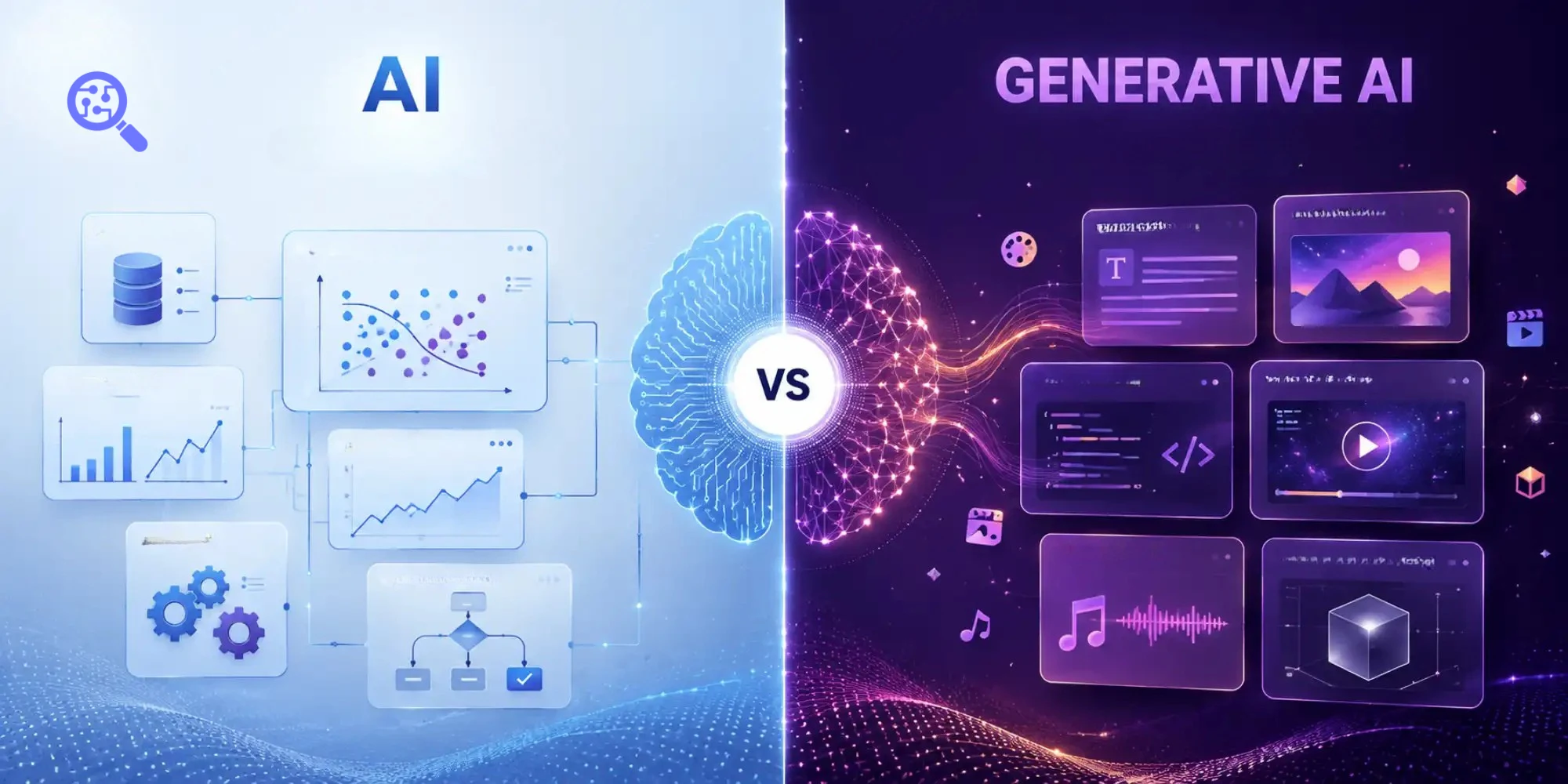
Artificial intelligence has been part of everyday technology for much longer than many people realize. When an email service filters spam, an online store recommends a product, a bank identifies an unusual transaction, or a navigation app predicts traffic, AI may be working behind the scenes. These systems typically analyze information, recognize patterns, make predictions, or help determine what should happen next.
Generative AI takes those capabilities in another direction. Instead of primarily classifying information or predicting an outcome, it can create new content such as text, images, audio, video, and software code. IBM defines generative AI as artificial intelligence capable of creating original content in response to a user's prompt or request.
The distinction matters more than ever because both technologies are becoming mainstream. According to the Stanford AI Index Report 2026, 88% of surveyed organizations reported using AI in at least one business function in 2025, up from 78% in 2024. Regular use of generative AI reached 79%, compared with 71% a year earlier.
Despite that rapid adoption, AI and generative AI are not interchangeable terms. Artificial intelligence is the broader field, while generative AI is a type of AI designed to generate new content. Understanding this difference makes it easier to choose the right technology and see where newer developments such as multimodal models and AI agents fit into the wider AI landscape.
AI vs. Generative AI: Quick Answer
Artificial intelligence (AI) is the broader field of building computer systems capable of tasks associated with human intelligence, including learning, comprehension, problem-solving, decision-making, pattern recognition, and varying levels of autonomy.
Generative AI (GenAI) is a type of artificial intelligence that learns patterns and relationships from data and uses them to generate new outputs, including text, images, software code, audio, and video.
For example, an e-commerce business could use traditional AI to analyze a customer's purchase history and predict which product they are most likely to buy next. The same company could use generative AI to create a personalized product description or marketing message for that customer. Both applications use AI, but they solve different problems.
The simplest way to remember the relationship is: all generative AI is AI, but not all AI is generative AI.
AI vs. Generative AI at a Glance
Feature | Artificial Intelligence | Generative AI |
Definition | Broad field of intelligent computer systems | Type of AI focused on generating new content |
Main purpose | Analyze, classify, predict, recommend, optimize or decide | Create, transform, summarize or synthesize |
Typical output | Predictions, scores, classifications and recommendations | Text, images, audio, video and code |
Common uses | Fraud detection, forecasting, recommendations | Writing, image creation, coding, video generation |
Typical input | Structured and unstructured data | Prompts, documents, images, audio and other context |
Examples | Spam detection, recommendation engines | AI chatbots, image generators, coding assistants |
Key risks | Bias, prediction errors, privacy | Hallucinations, bias, privacy, copyright |
Relationship | The broader category | A subset of AI |
The distinction is becoming less visible in modern products because a single application can combine several approaches. A platform might use predictive AI to understand what a user needs, generative AI to create an appropriate response, and an AI agent to carry out an approved next step.
What Is Artificial Intelligence (AI)?
Artificial intelligence refers broadly to technology that enables computers and machines to perform capabilities associated with human intelligence. IBM's 2026 AI guide includes learning, comprehension, problem-solving, decision-making, creativity, and autonomy within this broader definition.
AI is therefore much broader than chatbots or content-generation tools. An AI system might recognize an object in an image, identify suspicious financial activity, predict future demand, rank search results, recommend a movie, optimize a delivery route, or determine whether an incoming email looks like spam.
Consider a streaming service that recommends what you should watch next. The underlying system can analyze your viewing history and compare patterns across many users before predicting which programs are most relevant to you. It does not need to create a new movie or television show to qualify as artificial intelligence because prediction and recommendation are themselves AI tasks.
The same principle applies across industries. Banks can use AI for fraud detection, manufacturers can predict equipment failures, retailers can forecast inventory demand, and cybersecurity systems can identify unusual activity. These examples demonstrate why AI should not be treated as a technology that began with the recent generative AI boom.
What Is Generative AI?
Generative AI is a branch of artificial intelligence focused on creating new content or data. Generative models learn patterns and distributions from training data and then use what they have learned to produce new outputs in response to input from a user or another system.
The generated output can take many forms. Large language models can produce text and software code, while other generative models can create images, speech, music, video, and synthetic data. Multimodal models increasingly work across several of these formats within the same system.
Instead of asking AI whether an email is spam, a user might ask generative AI to write an email. Instead of predicting which advertisement will perform best, a marketing team might use generative AI to create several advertising concepts that can then be tested. A developer might use traditional analysis tools to identify a software problem and generative AI to suggest or produce the code needed to fix it.
Generative AI commonly relies on sophisticated deep-learning models that identify relationships within large amounts of training data and use those patterns to generate relevant new outputs.
Its rapid rise is also visible in investment. Stanford's 2026 AI Index reports that global private AI investment increased 127.5% in 2025, while generative AI investment grew by more than 200% and captured nearly half of all private AI funding. The number of newly funded AI companies increased by 71%.
What Is the Difference Between AI and Generative AI?
The main difference between AI and generative AI is their scope and purpose. AI is the broader technology category, while generative AI is a type of AI primarily designed to create new outputs or transform existing information.
Understanding the differences becomes easier when we look at how each technology is used.
1. AI Is the Broader Category
Artificial intelligence includes many different technologies and approaches. Machine learning, deep learning, computer vision, natural language processing, predictive models, recommendation systems, robotics, and generative AI can all exist within the wider AI ecosystem.
Generative AI is therefore not an alternative to artificial intelligence. It belongs within it.
This is similar to the relationship between vehicles and electric cars. An electric car is a vehicle, but not every vehicle is an electric car. In the same way, generative AI is artificial intelligence, but artificial intelligence includes many systems that are not generative.
2. Their Main Goals Are Different
Many traditional AI systems are built to recognize, classify, predict, recommend, detect, or optimize. A bank may use AI to determine whether a transaction is suspicious, while a retailer might use it to forecast how many units of a product will sell next month.
Generative AI is primarily useful when the required output involves creating, transforming, explaining, summarizing, or synthesizing information. A retailer might use it to generate product descriptions, while a financial company could use it to summarize information for an analyst.
Neither approach is automatically better. Their value depends on the problem being solved.
3. Traditional AI Often Predicts, While Generative AI Creates
Consider a fashion retailer that wants to improve inventory planning and marketing. A predictive AI system could analyze historical sales, seasonality, customer behavior, and other data to estimate how many jackets are likely to sell next month. A generative AI system could then use information about those products and customers to create descriptions, advertising concepts, promotional images, or personalized messages.
The retailer can use both because each handles a different part of the workflow. Predictive AI helps determine what is likely to happen, while generative AI can help create what should be produced in response.
4. Their Outputs Are Usually Different
Traditional AI frequently produces a score, prediction, classification, recommendation, or decision. A fraud-detection model might assign a transaction a risk score, while a recommendation engine could rank ten products according to how relevant they are to a particular customer.
Generative AI typically produces richer content. A language model can generate paragraphs of text or software code, while image, audio, and video models can create new media.
Modern systems increasingly blur this boundary because generative models can also analyze information, while traditional predictive models may operate behind the scenes within a generative application.
5. Their Risks Can Be Different
Both types of AI can make mistakes, but those errors can appear differently. A predictive model might produce an inaccurate forecast because its data is incomplete, biased, outdated, or poorly suited to current conditions.
Generative AI introduces the additional problem of hallucination, where a model can produce information that appears plausible but is inaccurate or unsupported.
This remains important in 2026. Stanford evaluated 26 leading models on a new accuracy benchmark and found hallucination rates ranging from 22% to 94%. The AI Incident Database also recorded 362 documented AI incidents in 2025, compared with 233 in 2024.
These findings do not mean every generative AI response is unreliable. They show why the level of human verification should reflect the consequences of an error. Generating headline ideas requires far less scrutiny than relying on AI-generated information for medical, financial, legal, or academic decisions.
How Widely Are AI and Generative AI Used in 2026?
AI is now firmly established in mainstream business use. The latest Stanford AI Index reports that 88% of surveyed organizations used AI in at least one business function in 2025, while 79% regularly used generative AI in at least one function. More than half of respondents said their organizations were using AI across at least three business functions.
These numbers are useful because they show how quickly generative AI has moved from experimentation into normal business workflows. At the same time, they do not suggest that predictive or analytical AI is disappearing. Companies continue to use recommendation systems, forecasting models, fraud detection, classification, computer vision, and optimization alongside generative models.
The distinction between AI and GenAI therefore remains useful even as individual products increasingly combine them.
AI vs. Generative AI Examples in Everyday Life
The difference is particularly clear when both technologies are applied to the same industry.
Use Case | Traditional AI | Generative AI |
Search | Ranks relevant information | Generates a direct response |
E-commerce | Recommends products | Creates product descriptions |
Banking | Detects suspicious transactions | Produces financial summaries |
Healthcare | Identifies patterns and predicts risk | Drafts or summarizes documentation |
Coding | Detects bugs or anomalies | Generates and modifies code |
Marketing | Predicts customer behavior | Creates campaign content |
Customer support | Classifies customer requests | Generates conversational responses |
Education | Analyzes student performance | Creates explanations and exercises |
Cybersecurity | Detects unusual activity | Generates incident summaries |
Media | Recommends content | Generates text, images, audio or video |
A modern customer-support system demonstrates how these capabilities can work together. Traditional AI might classify an incoming request and predict its urgency, generative AI could prepare a response using relevant company information, and an agent could potentially update the customer's account after receiving the necessary permission.
AI vs. Generative AI: Which One Do You Need?
The right technology depends on the problem rather than which type of AI sounds newer or more sophisticated.
Traditional or predictive AI is generally well suited to problems involving forecasting, classification, ranking, anomaly detection, recommendations, and optimization. If a retailer wants to forecast inventory demand or a bank wants to identify unusual transactions, a specialized predictive model may be more appropriate than a general-purpose generative system.
Generative AI becomes useful when the task involves creating or transforming information. This includes writing content, summarizing documents, generating software code, creating visual assets, translating information, producing personalized communications, and answering questions using natural language.
Many organizations need both. A business can use predictive AI to determine which customer is likely to purchase a product and generative AI to create a personalized message for that customer. The practical question is therefore not "AI or generative AI?" but "Which type of AI fits each part of this workflow?"
Benefits and Limitations of Generative AI
Generative AI has become popular because it makes sophisticated forms of content creation and information processing accessible through relatively simple instructions. Employees can summarize large documents, developers can receive assistance with code, marketers can explore campaign concepts, and customers can interact with conversational systems using everyday language.
Its biggest advantages include faster content creation, rapid ideation, personalization, natural-language interaction, summarization, translation, and the ability to automate parts of repetitive workflows. IBM also identifies efficiency, creativity, personalization, and faster decision support among the potential benefits of generative AI.
The limitations are equally important. Generative AI can hallucinate facts, amplify biases, misunderstand context, and produce inconsistent outputs. Businesses also need to consider how sensitive information is handled, whether data is retained or used for training, and whether generated material introduces copyright or regulatory concerns.
The safest approach is to match human oversight to risk. A generated social-media caption can usually tolerate more experimentation than an AI-produced legal summary or financial recommendation.
Is Generative AI Replacing Traditional AI?
Generative AI is not replacing traditional AI. Instead, it is expanding what artificial intelligence can do and increasingly working alongside predictive and analytical systems.
Recommendation engines, computer vision, forecasting, fraud detection, optimization, classification, and anomaly detection remain valuable because many business problems do not require new content to be generated.
A modern system can combine these capabilities in sequence. Predictive AI can determine what is likely to happen, generative AI can create an appropriate response, and agentic AI can potentially take the next action.
A useful shorthand is:
Predict → Generate → Act
IBM distinguishes these concepts in a similar way, describing generative AI as primarily focused on producing new content while agentic AI is designed to pursue goals, make decisions, and perform tasks with greater autonomy.
The emergence of agents therefore does not make traditional or generative AI obsolete. It creates another layer that can connect existing AI capabilities into broader workflows.
What Comes After Generative AI?
The next stage of AI is already taking shape through multimodal models, AI agents, personalized assistants, specialized systems, and deeper software integration.
Multimodal AI allows a model to work with combinations of text, images, audio, video, documents, and other information. Instead of using separate applications for every format, users can increasingly ask one system to understand several types of data together.
AI agents extend this idea from generation toward action. An agent can potentially interpret a goal, decide which steps are required, use external tools, retrieve information, and perform approved actions. This represents a meaningful change from AI that only responds with content.
At the same time, specialized AI is growing across coding, healthcare, research, marketing, finance, legal work, design, education, and other industries. These products can combine general models with domain knowledge, proprietary data, and workflows designed around a specific profession.
The next phase of AI is therefore unlikely to be simply about generating more content. It will increasingly focus on understanding context, connecting different capabilities, and completing useful work.
How to Find the Right AI or Generative AI Tool
As AI products become more specialized, simply searching for an "AI tool" is becoming less useful. Two products described using the same broad label may solve entirely different problems.
Start with what you need the system to accomplish. Determine whether the goal is to predict an outcome, analyze information, generate content, automate a repetitive task, or complete a multi-step workflow. Once the problem is clear, compare products based on output quality, integrations, privacy, pricing, model options, ease of use, and how much human review they require.
This is where AI Tool Hunt fits into the discovery process. The directory helps users explore AI products by category and use case, making it easier to discover specialized tools and alternatives instead of relying only on the most recognizable general-purpose AI platforms.
As the AI ecosystem grows, choosing the right tool will increasingly depend on matching a specific capability to a specific problem rather than choosing whichever AI brand receives the most attention.
Final Thoughts
Artificial intelligence and generative AI are closely connected, but they are not interchangeable. AI is the broader field, covering systems designed for prediction, classification, recommendation, recognition, optimization, decision-making, content generation, and many other intelligent tasks. Generative AI is a type of AI focused on generating or transforming outputs such as text, images, audio, video, and code.
The distinction matters more as adoption grows. Stanford's latest data shows that 88% of surveyed organizations now use AI in at least one business function, while 79% regularly use generative AI in at least one function. These technologies are increasingly being deployed alongside each other rather than competing for the same role.
The most useful question is therefore not whether AI or generative AI is better. It is which technology is best suited to the problem you need to solve. Predictive AI can help identify what is likely to happen, generative AI can create an appropriate response, and agentic AI can increasingly help carry out the next action.
If there is one distinction worth remembering, it is this: all generative AI is AI, but not all AI is generative AI.
Check also:
Frequently Asked Questions
Featured AI Tools





Top Categories
You Might Also Enjoy
More articles from our blog that you may find interesting.

Best AI Tools for Architects and Designers in 2026
Artificial intelligence is moving beyond experimental image generation and becoming part of practica...

10 Best AI Tools for Lawyers in 2026
Artificial intelligence is becoming part of everyday legal work. Lawyers can now use specialized AI...

10 Best Generative AI Development Companies in 2026
Generative AI has changed what businesses expect from software. Companies are moving beyond simple c...

AI in Healthcare Statistics 2026
AI is now part of routine medical work for many clinicians, but using an AI tool is not the same as...

10 Top Machine Learning Companies in 2026
Machine learning has moved from an experimental technology into infrastructure that businesses use f...

Scholarcy vs SciSpace
Reading academic literature has always required more than finding a paper and scanning its abstract....