
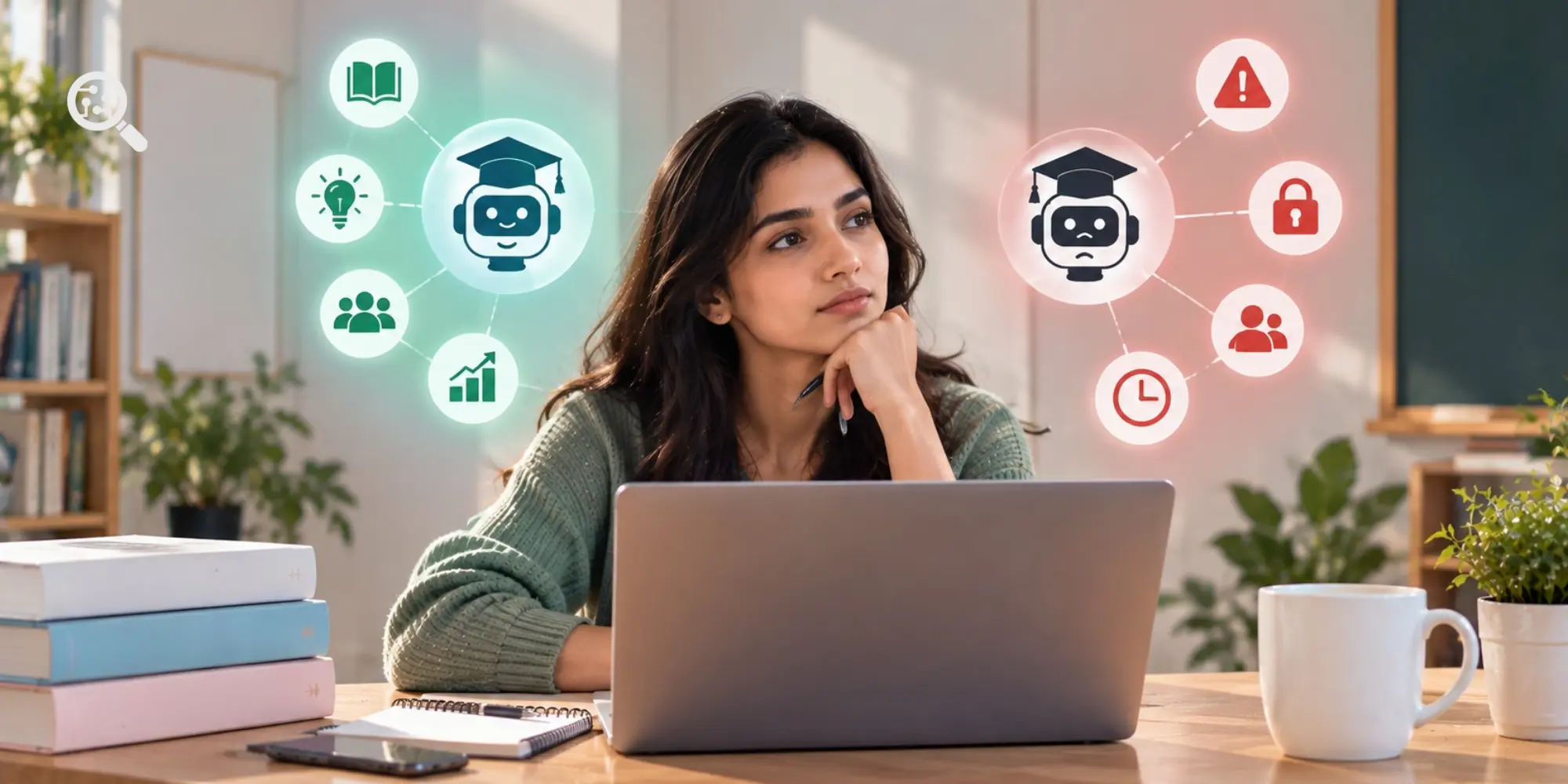
Artificial intelligence has moved quickly from being an experimental technology to something students and teachers encounter in everyday education. Students can use AI to understand difficult concepts, improve their writing, summarize information, prepare for exams, and find research material. Teachers, meanwhile, can use it to prepare lessons, create practice questions, adapt learning materials, and reduce time spent on repetitive tasks.
The adoption numbers show how quickly this shift is happening. Research cited in the reference material indicates that 86% of students use AI in their studies, with 24% using it daily and 54% using it weekly. Another education study reports that 60% of teachers have incorporated AI into their teaching.
However, greater use does not automatically mean better education. AI can personalize learning, improve accessibility, and save teachers time, but it can also provide inaccurate information, make academic dishonesty easier, create privacy concerns, and encourage students to depend on technology instead of developing their own skills.
Understanding both the advantages and disadvantages of AI in education is therefore important for students, teachers, parents, and educational institutions deciding how the technology should be used.
What Is AI in Education?
AI in education refers to the use of artificial intelligence technologies to support teaching, learning, assessment, research, and educational administration. These systems can analyze information, recognize patterns, generate content, answer questions, and sometimes adapt their responses according to a student's needs.
Examples include AI tutors, AI writing tools, adaptive learning platforms, automated assessment systems, translation tools, AI research tools, and educational chatbots. Artificial intelligence can also work behind the scenes, helping institutions analyze student performance or automate routine administrative processes.
The important point is that AI in education is not a single tool. It includes a wide range of technologies used for different purposes, from helping a student understand an equation to helping a university answer common admissions questions. Students and teachers who want to explore these technologies can browse AI tools for education based on their specific learning needs.
Advantages and Disadvantages of AI in Education at a Glance
Advantages of AI in Education | Disadvantages of AI in Education |
Personalized learning | Over-reliance on technology |
Faster feedback | Incorrect or misleading information |
24/7 learning assistance | Academic dishonesty |
Reduced teacher workload | Student data privacy concerns |
Better accessibility | Algorithmic bias |
Faster research | Reduced critical thinking |
Identification of learning gaps | Less human interaction |
Interactive learning | Unequal access to technology |
Administrative automation | Training and implementation challenges |
The same technology can produce very different outcomes depending on how it is used. An AI assistant that explains why a student's answer is incorrect can support learning, while one used to complete an entire assignment may remove much of the learning process.
Advantages of AI in Education
1. Personalized Learning for Different Students
Students rarely learn at exactly the same speed. One student may understand a mathematics concept immediately, while another needs additional explanations and several examples before it makes sense. Providing that level of individual attention can be difficult when one teacher is responsible for an entire class.
AI-powered learning systems can analyze student performance and adjust the difficulty, pace, or type of material accordingly. A student struggling with fractions might receive additional practice, while someone who has already mastered the topic could move on to more challenging work.
This doesn't mean AI replaces the teacher. Instead, personalized learning with AI can give educators another way to respond to different learning needs within the same classroom. The reference material similarly identifies personalized learning as one of AI's major educational benefits.
2. Learning Support Outside the Classroom
Students don't only need help during school hours. Someone revising late in the evening may get stuck on a concept when their teacher or tutor isn't available, and AI-powered educational assistants can provide explanations, examples, and practice questions at almost any time.
How students use that support matters. Asking AI to explain photosynthesis using a simpler example can help someone understand the topic, whereas asking it to complete an entire biology assignment removes much of the effort required to learn it. Used carefully, AI can function as an additional learning assistant rather than simply an answer generator.
3. Faster Feedback for Students
Traditional feedback often takes time because teachers need to review work from many students. AI can provide quicker initial feedback on areas such as grammar, sentence structure, quiz responses, language practice, and some types of problem-solving exercises.
Students can then correct mistakes while the material is still fresh in their minds. An AI writing assistant, for example, might identify unclear sentences before an essay is submitted, giving the student an opportunity to revise the work independently.
Teacher feedback remains important because AI may identify a grammatical problem while missing originality, reasoning, or context. The value lies in using AI for immediate first-level feedback while keeping educators involved in deeper assessment.
4. Less Repetitive Work for Teachers
Teaching involves considerable work outside classroom instruction. Educators prepare lessons, create exercises, write rubrics, adapt resources for different ability levels, review assignments, and handle administrative responsibilities.
AI can speed up some of this repetitive preparation. A teacher could generate an initial set of practice questions and then review and modify them, or create several reading exercises at different difficulty levels from the same source material.
The objective isn't to automate teaching itself. It is to reduce routine work so teachers have more time for discussion, mentoring, individual support, and other activities where human involvement matters most. The reference material similarly describes teachers using AI for lesson preparation, assessments, and learning materials.
5. Improved Accessibility
One of the strongest benefits of AI in education is its potential to make learning material more accessible. Speech-to-text, text-to-speech, automatic captions, translation, and adaptive interfaces can help students interact with material in ways that better match their needs.
A student with hearing difficulties may benefit from real-time captions, while someone who struggles with written text may use text-to-speech. Multilingual students can use translation and vocabulary assistance when unfamiliar language becomes a barrier to understanding a subject.
These applications show how AI can do more than make education faster. In some cases, it can remove barriers that previously made learning considerably more difficult. The UCW reference also identifies speech-to-text, text-to-speech, and real-time translation as important accessibility applications.
6. Faster Research and Information Discovery
AI can make the early stages of research much more efficient. Students can use AI research tools to understand unfamiliar terminology, summarize complicated material, identify related concepts, or develop questions that guide further investigation.
However, AI should support research rather than become the research source itself. Students still need to consult original materials, evaluate sources, check facts, and form their own conclusions because generative AI can provide inaccurate or incomplete information.
Used this way, AI can reduce the time spent finding a starting point without removing the critical thinking required to conduct reliable academic research.
7. Earlier Identification of Learning Gaps
Teachers working with large groups of students may not immediately notice every pattern in assessment results or classroom performance. AI-assisted analytics can help identify recurring mistakes, changes in performance, or concepts that many students are struggling to understand.
If a class performs reasonably well overall but repeatedly gets one particular type of equation wrong, the pattern could indicate that the topic needs to be revisited. Similar analysis can help identify individual students who may need additional support.
These insights should inform teachers rather than make decisions for them. Human judgment is still necessary to understand why a student is struggling and what kind of support would actually help.
8. More Interactive Learning Experiences
AI can be combined with simulations, virtual reality, augmented reality, and educational games to make difficult concepts more interactive. Students can practise skills in simulated environments or explore subjects that would otherwise be difficult to experience directly.
Medical education provides a useful example. The UCW reference discusses AI-supported virtual environments in which students can practise procedures in a controlled setting before encountering similar situations in real life.
Interactive technology won't make every lesson better, but it can give teachers additional ways to explain subjects that are difficult to communicate through textbooks or lectures alone.
9. Support for Multilingual Learning
Language can prevent students from fully understanding material even when they understand the underlying subject. AI translation tools can help translate instructions, explain unfamiliar vocabulary, support pronunciation, and provide simpler explanations.
Automated translation is not perfect, particularly when dealing with technical language, cultural meaning, or context. It can nevertheless provide useful support that allows multilingual students to work more independently while teachers provide additional guidance where necessary.
10. Automation of Administrative Tasks
The role of AI in education extends beyond teaching. Schools and universities also handle scheduling, enrolment, records, admissions questions, routine communication, and many other administrative processes.
Some repetitive tasks can be partially automated using AI workflow tools. An AI assistant might answer common questions about application deadlines, for example, while staff concentrate on unusual or complicated cases that require individual attention.
Administrative automation may be less visible than an AI tutor, but reducing routine workloads can free educational staff to spend more time supporting students.
Disadvantages of AI in Education
1. Over-Reliance Can Weaken Independent Thinking
One of the biggest risks of AI in education is that it makes avoiding difficult mental work extremely easy. Learning often requires struggling with an idea, making mistakes, revising an answer, and trying again before understanding develops.
If students ask AI for an answer every time something becomes difficult, they may finish assignments more quickly without developing the skills those assignments were designed to teach. Writing, mathematics, research, and problem-solving are particularly vulnerable to this kind of dependence.
The challenge is therefore not simply preventing students from using AI. It is teaching them to use it without outsourcing their thinking. The supplied references similarly warn that excessive dependence on AI can weaken critical-thinking and problem-solving skills.
2. AI Can Produce Incorrect Information
A well-written AI response can appear authoritative even when parts of it are wrong. Generative AI systems may misinterpret questions, mix accurate information with errors, invent details, or provide references that don't support the claims being made.
This makes verification an essential part of AI literacy. Students need to learn to check where information came from, compare it with reliable sources, and question an answer even when it sounds convincing.
In that sense, AI creates both a risk and a new educational responsibility. Students need stronger information-evaluation skills precisely because generating plausible information has become so easy.
3. Academic Integrity Becomes Harder to Manage
Generative AI can produce essays, homework answers, computer code, summaries, and presentations within seconds. This makes it much easier for students to submit work they didn't genuinely create or understand.
At the same time, treating every use of AI as cheating isn't particularly practical. Asking an AI tool to explain a concept, suggest improvements to a student's own draft, or create practice questions is fundamentally different from asking it to write the final assignment.
Schools therefore need clear rules explaining where assistance ends and academic misconduct begins. The concern is significant: a survey cited by UCW found that 84% of educators worry students' skills could erode because AI creates opportunities for cheating.
4. Student Privacy and Data Security
Educational AI tools may process sensitive information, including student writing, academic performance, learning patterns, and potentially behavioural data. That raises important questions about where information is stored, who can access it, how long it is retained, and whether it may be used to train AI models.
Schools and universities should evaluate these issues before adopting a platform rather than assuming that every educational AI product handles student information in the same way. Students should also avoid entering sensitive personal or institutional information into tools without understanding how that information will be handled.
Privacy becomes especially important when AI is integrated deeply into learning systems rather than used occasionally for general questions.
5. Bias Can Affect AI Outputs
AI systems learn from large datasets that may contain historical, cultural, or social biases. As a result, an AI-generated recommendation or assessment can appear neutral while still reflecting problems within its underlying data or design.
The risk becomes more serious when AI is involved in grading, admissions, student recommendations, or other decisions that could affect educational opportunities. Human review is therefore essential whenever an automated output could have meaningful consequences for a student.
6. Reduced Human Interaction
Good education involves far more than transferring information. Teachers notice confusion, encourage students who have lost confidence, understand classroom dynamics, and provide emotional support that software cannot reliably reproduce.
An AI tutor may answer questions at any hour, but constant availability isn't equivalent to a relationship with a teacher. Excessive dependence on automated learning could therefore make education more efficient while simultaneously making it less personal.
The reference material makes the same distinction, emphasizing that mentorship, empathy, and emotional support remain important parts of human teaching.
7. Unequal Access Can Widen the Digital Divide
Not every student has a modern computer, reliable internet connection, or access to premium AI platforms. Some students may be able to use advanced paid models whenever they want, while others depend on shared devices or limited free access.
If schools begin designing assignments around AI without addressing these differences, existing inequalities could become wider. Access to suitable technology therefore needs to be considered alongside curriculum design and AI policy.
8. Teachers Need Training and Clear Guidelines
Giving educators access to AI software does not automatically improve teaching. Teachers need to understand what a tool can do, where it can fail, how its outputs should be checked, what student information can safely be entered, and when using AI would be inappropriate.
Institutions also need clear objectives rather than adopting technology simply because it is new. The reference material recommends teacher training, appropriate infrastructure, clear goals, ongoing professional development, and regular evaluation as part of responsible AI implementation.
What Does AI Mean for Students and Teachers?
For students, the impact of AI depends largely on which part of the learning process it supports. Using AI to receive another explanation, practise a skill, organize research, or get feedback can improve learning. Using the same technology to generate an assignment from beginning to end can produce a polished result without developing much understanding.
For teachers, AI is most useful when it handles repetitive or preparatory tasks while leaving important educational decisions to people. Lesson-planning support, differentiated materials, basic feedback, and performance analysis can save time, but motivation, mentoring, assessment context, and student relationships still require human judgment.
This balance is likely to become increasingly important as AI tools for education become a normal part of learning rather than separate technologies students occasionally experiment with.
The Future of AI in Education
The future of AI in education is unlikely to be a classroom where software simply replaces teachers. A more realistic direction is AI becoming quietly integrated into the tools students and educators already use, including learning platforms, accessibility software, research systems, assessment tools, and administrative services.
Personalized tutoring may become more sophisticated, while teachers may spend less time preparing routine materials. At the same time, education may need to place greater emphasis on critical thinking, source verification, original reasoning, communication, collaboration, and digital literacy.
As AI becomes increasingly capable of producing answers, knowing how to question, verify, and improve those answers may become just as important as knowing how to generate them. The future of AI in education will therefore depend as much on how people learn to use the technology as on how capable the technology becomes.
Conclusion
The advantages and disadvantages of AI in education often come from the same capabilities. Instant responses can provide students with learning support whenever they need it, but they can also make academic dishonesty easier. Data analysis can identify learning gaps and personalize education, while the collection of that data creates legitimate privacy concerns.
The most useful approach is neither to reject AI nor allow it to take over the learning process. Schools can use AI to reduce repetitive work, improve accessibility, provide additional support, and make learning more flexible while keeping teachers and students responsible for judgment, creativity, verification, and critical thinking.
AI has the potential to improve education, but its value will ultimately depend on how thoughtfully students, teachers, and institutions choose to use it.
People are also reading:
Frequently Asked Questions
Featured AI Tools





Top Categories
You Might Also Enjoy
More articles from our blog that you may find interesting.

Scholarcy vs SciSpace
Reading academic literature has always required more than finding a paper and scanning its abstract....

AI in Real Estate Statistics 2026: Market Size, and 2030 Forecast
Artificial intelligence is already part of everyday real estate work, but the industry is at an unus...
Google Translate vs ChatGPT: Which Is Better in 2026?
Google Translate and ChatGPT can both translate a sentence in seconds, but they are no longer compet...
n8n vs Make (2026): Features, Pricing & Which Is Better?
Choosing between n8n and Make is no longer simply about finding a tool that can connect one app to a...
Generative AI vs Machine Learning: Key Differences Explained
Generative AI and machine learning are closely related, but they are not interchangeable terms.Machi...

What Is AI Marketing? Benefits, Uses & Strategies for 2026
Marketing teams have always tried to answer the same basic questions: Who is most likely to buy? Wha...